What we do
What does a small foundation actually do? Five things, set out below. The grants those activities produce pay for a specific, structured music curriculum in schools.
Our first initiative is a partnership with Gen C Coffee and Bloom Arts Foundation, with a goal of raising $1,000,000 for music programs in schools.
The split, plainly: The programs described here are designed and delivered by Bloom Arts Foundation, our program partner. Happy Gives Foundation raises the funding and grants it onward. We do not run classrooms, employ the teaching artists, or set the curriculum.
What we actually do.
Partnership Giving
We build giving partnerships with mission-aligned businesses, so everyday purchases and campaigns turn into charitable support. Our current partners are Gen C Coffee and Purity Coffee.
Instead of competing for the same donor attention as every other charity, we work upstream. We partner with businesses whose customers already care about the things we care about, and we build giving into what those businesses already do.
A purchase, a campaign or a company commitment turns into charitable support for music education, and nobody has to change their habits to make it happen.
Advisors and Program Review
Working music professionals and classroom teachers advise the Foundation. They help us look closely at a program before any money moves, and they help us push for structure a donor can see into.
Founder Happy Montana brings in working music professionals and classroom teachers as advisors. They have taught kids and run programs themselves, so they know what a good session looks like from the inside.
Their job is to help us look closely at a program before any money moves, and to help us push for structure that makes the work visible to the people paying for it.
Music Education Grantmaking
The contributions we raise are granted to arts education organizations that deliver music programming inside schools. Bloom Arts Foundation is our program partner for the first initiative.
We are a grantmaker, not a classroom operator. We hold and steward the contributions we raise, then grant them to arts education organizations that already have relationships inside schools and a record of delivering programming to students.
Backing one program partner at a time keeps the giving path short. A donor can see the organization that receives the money and the organization that spends it on kids.
Instruments and Instruction
Grant funding goes to the practical costs of school music: the instruments, the teaching support, the artist-led sessions. A kid's place in the room should not depend on what their family can pay.
Grant funding goes to the unglamorous costs that decide whether a school music program exists at all: the instruments, the people qualified to teach, and the working-artist sessions that show a kid what the instrument is for.
The intent is simple. No student should get sorted out of music because of what their family can pay.
Donor Transparency
We publish our IRS status, EIN and giving guidance openly, and every contribution we receive gets documentation and a gift acknowledgment letter.
Our legal name, EIN, mailing address and IRS Publication 78 status are published on this site and repeated on every page, so a donor or a grantmaker can verify us without emailing anyone.
Every contribution we receive gets documentation and a gift acknowledgment letter. Ask how a gift will be used and you get a direct answer.
The businesses that generate the support, and the four-step path a dollar travels, are set out on our partners page.
The Bloom Arc: a full academic year in six phases.
Bloom Arts Foundation, our program partner, delivers a six-phase developmental curriculum across a school year. Each phase builds a specific capability, and the sequence ends with kids composing work of their own.
That is how the first initiative began. Bloom Arts Foundation was already doing strong work in schools. Happy Gives supported them in building out a framework of structure around the work they were already doing.
We worked with them to shape one thing in particular: the curriculum is laid out so a donor can see directly into the real impact at each phase. You can see what is changing while it is changing, instead of hearing about it once the year is over.
- 1
Rhythm
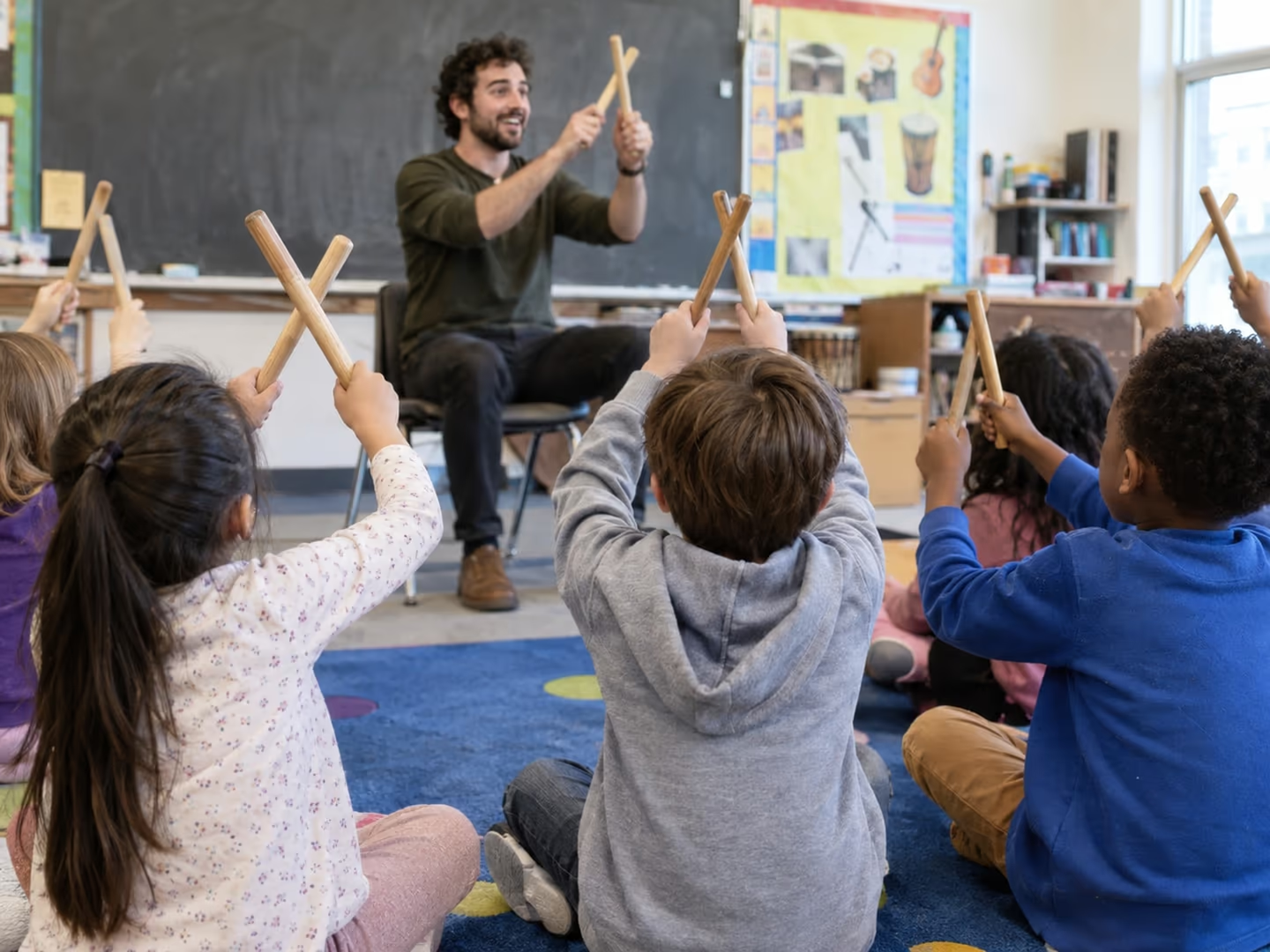
Finding and holding a beat.Body-based pulse work: walking in time, echo exercises, call and response. Rhythm is the base layer every later phase is built on, and a lot of kids now arrive without it.
What a donor can seeWhether a class can find and hold a beat together. You can hear it from the door.
- 2
Listening
Hearing others, not just yourself.Students learn to hear space and respond to each other rather than just perform. In an ensemble, leaving room matters as much as playing, and that habit carries well past the music room.
What a donor can seeKids leaving space for each other instead of playing over the top.
- 3
Voice
Discovering that your idea counts.Students get asked questions instead of only being told what to do, and their answers shape what the class makes. This is where feeling safe turns into being brave enough to try something.
What a donor can seeStudents answering out loud, and their ideas ending up in the music.
- 4
Leadership
Taking a turn out front.Groups of four to six students get a creative prompt, a few minutes to build something together, and then they show it to the class for feedback. Quiet kids get a turn to lead, not only the confident ones.
What a donor can seeSmall groups presenting work they built themselves, quiet kids included.
- 5
Ensemble
Playing a part inside a whole.Students play multi-part arrangements and learn every part rather than only their own, so any student can hold any role. Time, pulse, listening and flexibility all have to work at once.
What a donor can seeA class holding several parts at once, and swapping parts without falling apart.
- 6
Original Work
Making something that did not exist.Students compose. An original song, an original rhythm, a few bars of movement over a beat they invented. Bloom Arts reports that classes as young as preschool write their own music.
What a donor can seeMusic that did not exist before the school year started.
The instruments in the room.
Grant funding goes to the practical costs behind this list: the instruments themselves, and the working artists qualified to teach with them.
- Voices
- Hand drums
- Shakers
- Recorders
- Ukuleles
- Rhythm sticks
- Scarves
- Resonator bells
- West African Remo drums
- Gankogui bells
- Shekere gourd shakers
Who teaches, and how they are vetted.
We support programs that put working professional musicians in front of kids, rather than a generalist with a worksheet. Bloom Arts Foundation recruits performing musicians and gives them a structured framework for teaching in under-resourced schools.
Every one of their teaching artists is background-checked and fingerprinted, shadows the executive director before working independently, and is reviewed with feedback from classroom teachers, administrators and families. They are trained across PreK through 6th grade, including support for students with diverse learning needs.
Those artist-educators are placed on purpose, in under-resourced Los Angeles County schools.
The window closes around age nine.
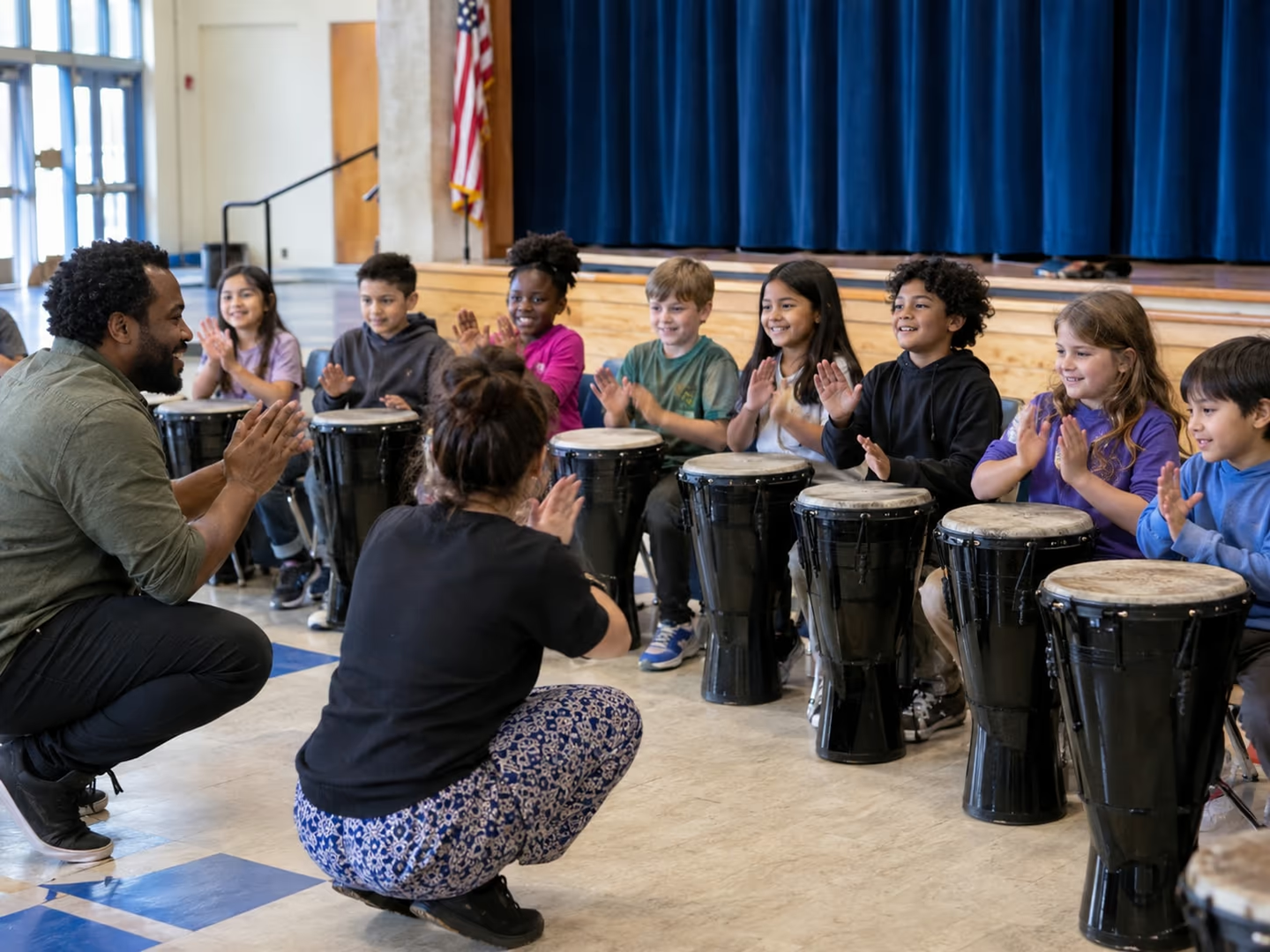
Musical and creative aptitude is most developable before roughly age nine. That finding comes from Gordon Music Learning Theory, and it is one of the reasons we fund where we fund.
Bloom Arts Foundation sees the consequence in its own classrooms. Students who reach fifth grade without early musical exposure often struggle to find a basic pulse, and it is not a talent problem. The window in which that skill forms most easily has already narrowed.
So money aimed at elementary and preschool classrooms does disproportionate work. That is where we concentrate grants.
The Bloom Arc rests on three established pedagogical frameworks.
- Orff Schulwerk
- Rhythm before notation, play before theory, and the premise that every person is innately musical.
- Gordon Music Learning Theory
- Musical aptitude is most developable early in childhood, which makes early exposure foundational rather than optional.
- Elements of Dance
- Body, action, space, time and energy. Movement treated as a language running alongside music.
Futures in Tune.
Futures in Tune is the international layer of Bloom Arts Foundation's work. Classrooms in different countries learn each other's songs, record their versions, and compose together across borders.
Each site is funded locally. Bloom Arts supplies the curriculum, coordination, recording and videography that hold the programs together.
Los Angeles · KwaZulu-Natal, South Africa · India · Zambia
Songs in English, Spanish, Zulu and Hindi
What Bloom Arts' own surveys report.
These are Bloom Arts Foundation's own survey results for its own programming. We reproduce them because they describe the work our grants support.
Increased sense of community and feeling included
Improved mood, enthusiasm and patience
More confidence to speak and participate in class
Boosted creative thinking and problem solving
Enhanced ability to work collaboratively
Source: Bloom Arts Foundation's own internal surveys of its own programming, reporting the share of students who improved. These figures belong to Bloom Arts Foundation and are not measurements by Happy Gives Foundation.
Help put this in front of more kids.
If your company wants everyday commerce to fund music for kids, or you want to understand how a contribution is documented and granted, we would like to hear from you.